
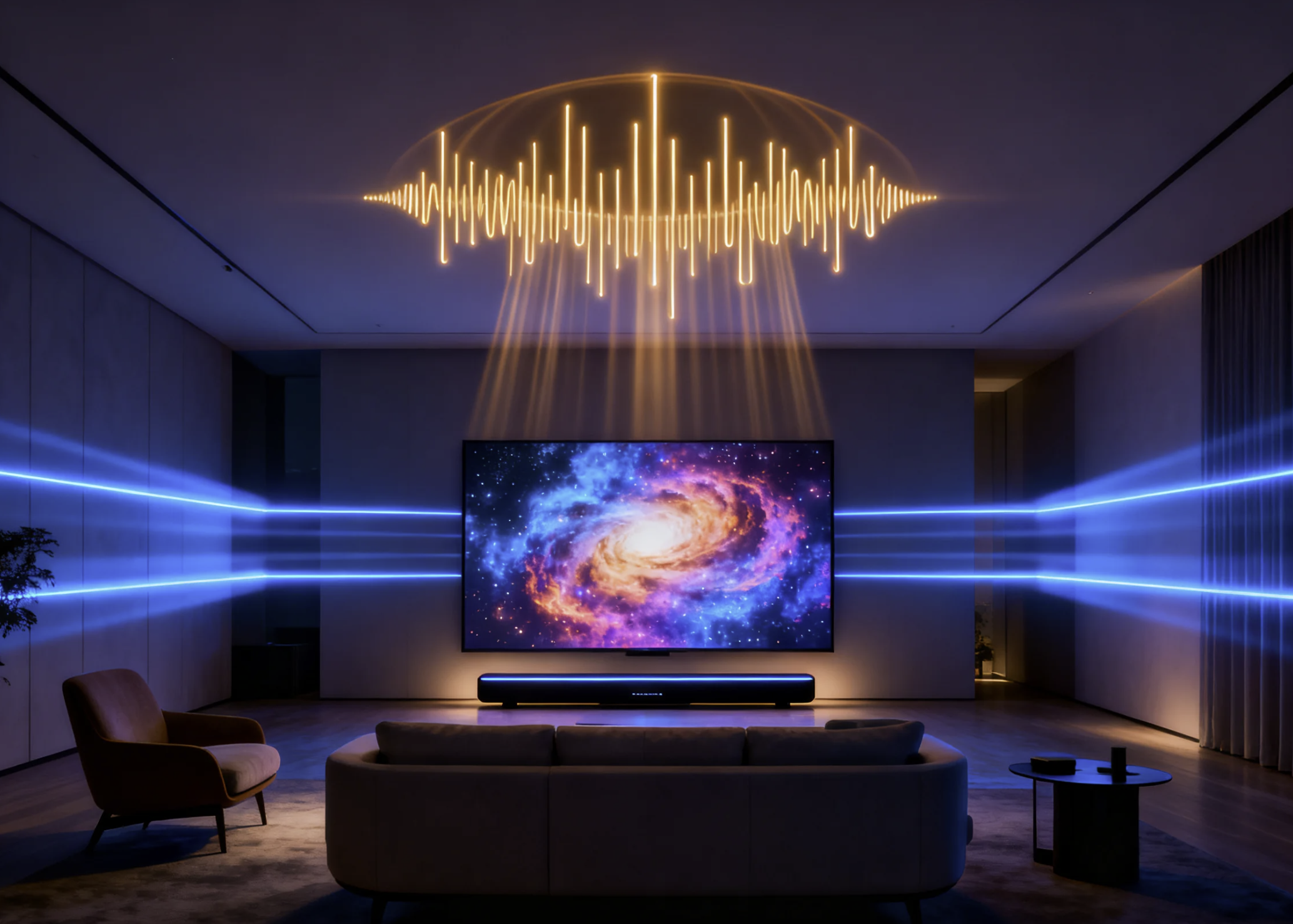
In the hyper-competitive arena of modern home theater, we routinely marvel at engineering marvels like the JBL BAR 1300. With its 11.1.4 channels and clever detachable wireless rear speakers, it represents the current zenith of plug-and-play spatial audio. Yet, as we immerse ourselves in the dome of sound created by Dolby Atmos, a fascinating historical puzzle emerges for audio enthusiasts: How did we get here? Was the sonic sorcery of yesteryear truly left behind, or does it live on in the DNA of today’s leading audio formats?
To answer this, we must look back at a groundbreaking فناوری pioneered by Yamaha over two decades ago: The Digital Sound Projector (Sound Beam). While not a direct corporate predecessor, Yamaha’s legacy shares an undeniable, symbiotic lineage with the modern Dolby Atmos revolution.
The Pioneer of Reflection: Yamaha’s “Laser Beams” of Sound
In 2004, home theater was an invasive species. True surround sound required drilling holes, running unsightly copper wires, and placing five to seven bulky physical speakers around a living room. Then came the Yamaha YSP-1.
Yamaha’s radical solution was to treat sound not as a generic wave, but as controllable “beams”—akin to acoustic lasers. By packing dozens of tiny, individually controlled micro-drivers into a single chassis, Yamaha utilized beamforming (wavelet phase delay) to fire tightly focused sound streams at the left, right, and rear walls of a room.
The Optical Illusion of Sound: By bouncing these audio beams off physical boundaries, Yamaha successfully tricked the human brain into believing there were physical speakers sitting directly behind them. It was a masterclass in exploiting 2D spatial boundaries.
The Genetic Shift: From Channel Reflection to 3D Up-Firing
When Dolby laboratories set out to democratize Dolby Atmos for the average living room, they faced an identical hurdle: No one wanted to hang heavy speakers from their ceilings.
Dolby’s solution? Look upward. And in doing so, they leaned directly into the reflection philosophy Yamaha had spent a decade perfecting.
| Feature / Tech | Yamaha Sound Beam (YSP Series) | Dolby Atmos (Modern Soundbars) |
| Acoustic Method | Horizonatal/Side Wall Reflection | Vertical/Ceiling Reflection (Up-firing) |
| Core Architecture | Channel-Based: Drives fixed 5.1/7.1 audio tracks via directed beams. | Object-Based: Treats sound as independent moving 3D coordinates. |
| Room Tolerance | Extremely strict; requires symmetrical, hard-walled rooms. | High; utilizes advanced AI calibration to map irregular spaces. |
Every time you watch a modern Dolby Atmos soundbar fire audio toward your ceiling to simulate an overhead helicopter, you are witnessing the direct evolution of Yamaha’s original beam-reflection concept. Dolby simply took Yamaha’s horizontal laser beams and pivoted them 90 degrees into the vertical axis.
Evolution’s End: The Rise of Computational Audio
If Yamaha’s Sound Beam tech was so brilliant, why did it fade from the flagship limelight, making way for the likes of Dolby Atmos and detachable physical rears?
The answer lies in the shift from physical dependence to algorithmic intelligence. Yamaha’s system was a fragile ecosystem; if your living room featured an open-concept kitchen on the left or heavy, sound-absorbing curtains on the right, the acoustic beam would dissipate, and the entire soundstage would collapse.
Dolby Atmos bypassed this by abandoning “channels” altogether in favor of Audio Objects. Concurrently, hardware evolved. Systems like the JBL BAR 1300 solved the rear-surround dilemma not by fighting the room’s architecture with reflected beams, but by physically detaching real, battery-powered speakers and letting AI Sound Boost algorithms handle the rest.
The Verdict
Yamaha’s Digital Sound Projector line was not a failed experiment; it was a necessary prophet. It taught the audio industry how to weaponize room reflections and proved that immersive audio could be achieved from a singular, elegant form factor.
While Dolby Atmos and modern computational soundbars have claimed the throne through advanced 3D object-tracking and modular wireless hardware, they stand firmly on the shoulders of the acoustic giant that came before them. The “beams” of the past have simply become the invisible sky-channels of our cinematic present.
Be First to Comment